Elspeth Cooper

Purveyor of fine fantasy adventures

Page 29 of 84

The trouble with comparisons

No, really, it's just like it.

No, really, it’s just like it.

There’s something that keeps cropping up in commentary about my books, specifically the first one, Songs of the Earth, which frustrates me no end, because I just don’t get it. At all. And that’s the recurring comparisons to Harry Potter*.

The latest of these occurred over at Fantasy Faction, which is an awesome site and the team that run it are long-term friends and supporters of my work. They just published their list of Top Anticipated Fantasy Novels of 2014, and were kind enough to include my forthcoming book The Dragon House at No. 20:


Why we are excited: Elspeth Cooper has some of the best prose we’ve ever come across. We were a little unsure about Gair and this series at first, but Elspeth has really taken this series from something a little too Harry Potter-esque to a series that walks its own path and that is increasingly epic and high-stake for its characters.


This is lovely stuff to hear, of course, and I’m deeply flattered to be included on a list with the likes of Daniel Abraham and Jim Butcher, Carol Berg and Elizabeth Bear. But there’s that reference to Harry Potter again. I’ve also had reviews that mention it. One reviewer on Amazon even went so far as to accuse me of totally ripping off Rowling’s books.

To which I have to say: Wuh?

Songs of the Earth is a coming-of-age story, like Harry Potter. This is hardly unique in the fantasy canon. Bildungsroman is one of the key themes of genre storytelling: finding out who you are, where you stand, and what you will not stand for. Songs also takes place in part in a school for magic, like Harry Potter. It’s far from alone in that too**.

But apart from that, there’s very little similarity between the two books. They’re set in different milieus (a magical-realism version of our world vs a secondary universe), aimed at a different audience, and feature very different protagonists (adult bastard nobody-special vs Chosen One boy wizard***).

Bloomsbury cover of Harry Potter & the Philosopher's Stone

A bit too Songs-of-the-Earth-esque?

Even the magic itself is not the same (elemental forces vs cod-Latin spells learned by rote). Maybe you could argue that there’s a minor thematic similarity between the renegade Guardian Savin and He Who Shall Not Be Named, in the sense that they’re both powerful mages gone rogue, but is that really enough to call a book “Harry Potter-esque”?

As for the ‘school for magic’, the two are similar only in concept. Hogwarts is recognisably an English boarding-school environment with Houses and common rooms and intramural sporting challenges. It is Tom Brown’s Schooldays with wands and brooms.

In Songs, I tried to play down the actual learning part because it’d been done before, not least by Rowling, so not one of Gair’s lectures or practical lessons is described on the page in real time. Book magic or learning by rote do not feature. This was because the studying bit was less important to me than exploring Gair’s relationships with others, be they friend, lover or mentor.

Yet the comparisons persist, and I just don’t understand why. My theory is that Harry Potter has had such an enormous impact on popular culture that it’s simply the first thing anyone thinks of at the merest hint of a school for magic – even though that element is probably the least significant part of my book.

Or maybe it’s the imagery of the Masters defending Chapterhouse at the end of Songs that makes them think of Professor McGonagall and Co defending Hogwarts in Harry Potter and the Deathly Hallows. I can’t help that: I wrote that scene before the first Harry Potter was even published (Honest. The oldest version of the manuscript I have accessible on this PC is datestamped 6 October 1996. Don’t make me dig out the original files on floppy disk).

Now don’t get me wrong; I’m not complaining. There are far worse books than Harry Potter to be compared to, after all, but at the same time I worry that these comparisons send the wrong message to potential readers (or worse yet, the parents of potential readers). That if you enjoyed Harry Potter, this book Songs of the Earth is quite like it, when it’s not. Not even a little bit.

So why do people who’ve read it, keep maintaining that it is?

***

* Disclaimer: I haven’t read the HP books, but I have seen the films. Any errors or omissions I make should be considered in this context.

** Just off the top of my head there’s Trudi Canavan’s Black Magician trilogy, in which Sonea learns to harness her abilities and rise through the ranks at the Magician’s Guild, and Pat Rothfuss’s The Name of the Wind in which the University is basically a school for magic on steroids.

*** Seriously. He’s got a distinguishing mark, his parents were killed in mysterious circumstances, and he was raised in obscurity to keep him safe. If he’d grown up on a farm he’d be Belgarion from the David Eddings books – or Luke Skywalker, the most massive example of the farm-boy-comes-of-age-and-saves-the-world trope in the history of ever.
 

Traditional fantasy: what does that mean to you?

People keep telling me I write traditional fantasy. They’re usually being nice when they say that, otherwise they probably would have called it derivative, so don’t get me wrong, I’m totally happy with the label. But to be honest with you, I’m not sure I know what ‘traditional fantasy’ even means. Or rather, I’m not sure what it means to them, the people using the term. Their perceptions may not be the same as mine.

That’s the thing with labels like ‘traditional’: I want to know whose traditions are being referenced. Y’know, just so we’re clear. There’s nothing worse than having a debate that isn’t actually a debate at all, because we’re talking about the same things, just using different terms to describe them.

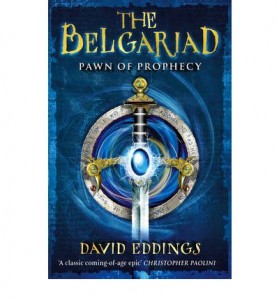
Cover of David Eddings' Pawn of ProphecyWhen I think of traditional fantasy, I default to the likes of David Eddings’ Pawn of Prophecy: a Chosen One raised in obscurity to keep him safe, who goes off on a quest with a motley band of adventurers (including a feisty girl that the bewildered, nice-if-a-bit-dim protagonist hates at first but will ultimately marry) leading to a glorious destiny at the end. Probably involving a throne. Black hats and white hats are readily identifiable, motives are rarely murky, and it’s a pretty good bet you know how it’s going to end.

Another trope that I closely associate with ‘traditional’ is the protagonist being somebody’s heir, descendant or a hero reborn. Their destiny is pre-determined and thus their agency is limited because of who they are, so I would put the Shannara books in that category too (although I gather that in later volumes the story tries to get ‘bigger’ and move beyond this). I’d likely throw The Wheel of Time in there too: it certainly started out that way, before Rand got over being a whiny brat, accepted his fate and owned it.

Speaking of prophecy, characters getting pushed around by one is yet another hallmark of what I’d class as traditional. After all, prophecy is a common motif in the myths and religious traditions that fuel much of our storytelling: Ragnarök, Achilles’ heel, auguries etc. As an indiscriminate and voracious teen reader I gobbled up fantasy like that, but these days it chafes a bit. I like to see more characters figuring stuff out as they go and getting thrown off track by their mistakes, rather than just following signposts.

A more general definition of traditional fantasy encompasses those stories which draw on a particular mythic heritage, usually European, usually set in a pseudo-medieval* secondary world, with non-urbanised, non-industrial feudal societies, before the invention of firearms. In other words, a society in which the existence of magic can’t be argued away by actual science. I can see why people would apply that definition to The Wild Hunt, although personally I don’t think the shoe quite fits. It’s pinching my toes and there’s a blister on my heel.

Balliol College Quadrangle (5647597466)

Balliol College, Oxford – founded in 1263

The Empire I wrote about has a state press (at least in the capital), mass-printed books, accurate clocks, mechanised weaving, quite widespread literacy, numerous universities, and some indoor plumbing, all referenced in the text, and none of it dependent on magic, only human ingenuity. By those lights, I wouldn’t call it ‘pseudo-medieval’ at all – it’s more ‘pseudo-early modern’.**

I’ve tried to portray it as a society on the verge of a technological leap: they already import fireworks, so it’s only a matter of time before someone starts looking closely at their explosive properties, and the military applications thereof.***

The Empire is also only a titular monarchy, and the Emperor does not have absolute power. He requires a consensus in his privy council, whose members are regional governors for each of the provinces in the Empire (which were once kingdoms in their own right) and if they chose to revolt, they could vote for the appointment of a new Emperor. Yes, really. No divine right of kings here.

There’s no band of plucky adventurers either. Most of the time Gair’s alone, or with one or two people, who are not constant companions but move in and out of the action as needed – and the feisty girl is an older woman who makes no secret of the way she feels.

I will cop to the wandering magus trope, however, and the fact that there is some mystery over Gair’s parentage, although I tried to poke fun at that a little:

‘You know, that has the ring of a story to it,’ Alderan said. ‘The orphaned boy with the crown-shaped birthmark that identifies him as the lost heir to the kingdom, and so forth.’

Gair shook his head. ‘No crowns. No kingdoms. Just a soldier’s brat put out to charity.’

— Songs of the Earth

The truth is exactly what Gair believes it to be: his mother couldn’t keep him and his foster family didn’t want to, so he ended up raised by the Church. But when the music stops and the story ends, he will not be the king of anything.

I used those tropes deliberately, knowing I would get flak for them, because they fitted the story I was telling. I’ll use whatever tools are available to me to build what I want. Besides, I’m nowhere near well-enough read in the genre to know the minutiae of everything that’s been done before and therefore attempt to create something entirely new; the story came first and the world evolved around it. If all this makes me a writer of traditional fantasy, then so be it.

So I circle back to the original question: what does traditional fantasy mean for you? Is it the setting, the plot, the protagonist’s origin story? Is it the archetypes the author uses, the mythos they chose to draw from? Does it even matter to you, as a reader, as long as the characters are engaging and the story’s fun?

Is a bit of tradition really a bad thing?

***

* A personal grumble of mine: I get a tad irritated when folk use the term ‘medieval’, which refers to the Middle Ages, as some kind of lazy catch-all for any pre-industrial society. The Middle Ages were on their way out by the time Gutenberg produced his folio Bible in 1455. Da Vinci’s Vitruvian Man and his anatomical sketches were maybe fifty years away,  and both Oxford and Cambridge had colleges that were by then already almost 200 years old.

** I studied early modern history, so I drew on that in building my world. The Tudor era, the dissolution of the monasteries, the Reformation, the whole nine yards.

*** Consider the proliferation of firearms in our world, spreading westwards from China into Europe in the 14th and 15th centuries, and the evolution of personal rather than battlefield weapons. Yes, considering the timelines of other technological developments I appropriated from European history, the Empire should probably have at least prototype mortars by now, but this was one area I deliberately chose not to explore in these books. I had plenty else to deal with. Besides, the trade routes up from the lands beyond Arkadie are risky, so it’s hard to bring new ideas home. Ships are lost all the time to storms and piracy. It’s entirely possible there are cast bronze cannon already languishing at the bottom of the Inner Sea with the Empire’s equivalent of the Mary Rose.


« Older posts Newer posts »

© 2026 Elspeth Cooper

Theme by Anders Norén — Up ↑